
The Streets We Never Take
\n
Sometimes the most interesting thing is not at the end of a journey, but one turn away from the route we know.
There are streets I have passed countless times without ever turning into them. I know where the traffic lights are, which bakery opens first in the morning, and where cars tend to queue. But what lies behind the next row of houses? I couldn’t tell you.
The other day, I found myself at one of those junctions again. Right would take me home, as usual. Left was a narrow street between older buildings. It was a grey afternoon. I had no appointment and no particular reason to take a detour. In the end, that was precisely why I did.
I turned left.
A Street Missing From My Mental Map
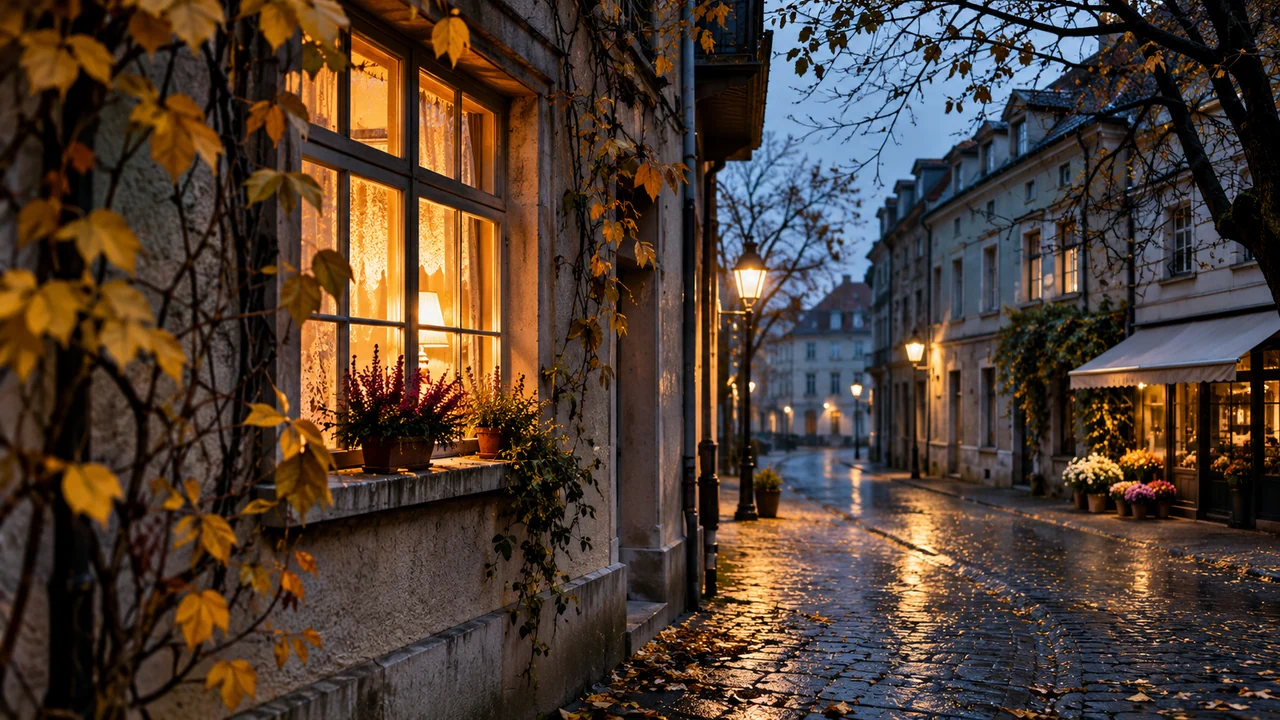
The first few metres were unremarkable: parked cars, closed windows, a rubbish bin beside the pavement. Then the noise faded. The main road slipped behind me, and I could hear my own footsteps on the stones.
Outside one house stood an old wooden chair with three flowerpots arranged on its seat, although hardly anything was still in bloom. Farther along, a handwritten note hung on a garden gate: “Please close the gate. Our cat is curious.” It made me smile. These are the small details you miss when you’re only trying to get somewhere.
At the end of the lane was a tiny square. No landmark, no café, not even a shop. Just two trees, a bench and a low wall. A single yellow leaf lay on the bench, shifting a little each time the wind caught it.
I sat down for a few minutes. Not because I was tired, but because, for once, there was nowhere I needed to arrive.
We Know Our Routes, But Do We Know Our Surroundings?
Habits make life easier. They save us from having to make decisions. We take the same route to work, walk through the same aisles in the supermarket, and even choose the same walking loop because we know exactly how long it takes.
There is nothing wrong with that. But something curious happens along the way: a living neighbourhood becomes familiar scenery. We know when to brake at the next traffic light, yet barely notice the buildings beside it. We see the road and overlook the life around it.
I wondered how often I had driven past this little square without knowing it existed. A hundred times, perhaps. Maybe more.
And then I thought about all the other things we fail to see because we assume we already know the place we live.
An Encounter I Hadn’t Planned
As I got up, an older woman crossed the square carrying a shopping bag. She stopped and asked whether I was waiting for someone. “No,” I said. “I’ve discovered this corner for the first time today.”
She laughed. “Then you’re one of the few people who manage to find it.”
We spoke for only two or three minutes. She told me there had once been a little repair shop on the corner. Her father used to take his bicycle there. Nothing remained of it now, she said, except a faded metal bracket on the wall.
I would have walked straight past it. Now I could see it: a rusty piece of metal barely bigger than my hand. Suddenly the lane was no longer just a collection of old houses. It had a story, given to me by someone simply because I’d stopped.
Not Every Detour Needs a Reward
We often expect something from a new route: a beautiful viewpoint, a hidden restaurant, a photograph worth sharing. If none of those things appears, we’re quick to call the outing disappointing.
But the best part of that afternoon was precisely that nothing dramatic happened. I didn’t have to document anything. Nobody expected a report. I was simply there, paying attention and listening to another person.
Perhaps a worthwhile detour isn’t about discovering something extraordinary. Perhaps it’s about noticing ordinary things again.
That idea applies to more than streets. Conversations often follow familiar routes too. We ask the same questions, offer the same answers, and assume we already know the people around us. Sometimes one unexpected question reveals something that has been there for years without our noticing.
The Way Back Was Familiar, Yet Different
Eventually I carried on. The narrow lane led back to the main road after all. It hadn’t been a grand diversion, more a small loop. Perhaps twenty minutes had passed.
When I reached the familiar junction again, it looked different. Not because anything there had changed, but because I now knew that behind that unremarkable turning were a quiet square, a story about an old workshop and a woman carrying her shopping.
Since then, I’ve tried taking a different street now and again. Not every day. Not as another obligation to put on a list. Just when I have the time.
And sometimes, standing at a junction, I ask myself: Am I turning right because that’s where I genuinely want to go? Or simply because it’s what I’ve always done?
Perhaps that’s a question worth asking outside our walks, too.